Showing posts with label cultural practices. Show all posts

Thursday, December 2, 2010

Field Trip to the East Side

Very early last Saturday, we met a friend on the east side of town -- the Neza municipality, if you know these parts. There aren't any high-rise, shiny glass buildings or anything of brand name. What you'll mostly find are simple cement homes housing the family business: snack shops, comida corrida restaurants, and car shops. Brilliant, I think, to live and work in the same place! The original work-from-home scheme. It's the way many Mexicans live but a world in which we know so little about living in our foreigner-friendly neighborhood. So, when the opportunity arises to see a different face of Mexico, I welcome it. Plus, you never know what fantastic food finds you might encounter.

We needed our car checked, and if there's one really good thing about the east side, it's the abundance of men who know how to fix cars. Even at 8 am on a Saturday morning, when there wasn't much going on in a usually crowded and vibrant area such as Neza, there were men everywhere fixing their cars. Oh, and if you ever wondered where the microbuses/peseros (small, green buses that terrorize the city) are maintained (they're maintained, you ask?!?), just go to Neza and take a look. Unfortunately, besides car guys and carts selling tamales and atole, I didn't get to see much. I think the real shenanigans start in the evening when the sun goes down.

This photo I took in Neza is something of a cultural curiosity to me. I've seen it many times before in various parts of the city -- the lack of attention to spelling. On you-can't-take-it-back permanent signage, no less. As a teacher, it makes me wonder how much schools here stress spelling?? We are sticklers for it in the US. I recognize the difficulty in distinguishing between v and b, but seriously, c'mon people, fabor?

By golly, these things do get repaired sometimes. Photo taken from the blog El Analfabeta, where the caption reads, "Pesero - Pequeño autobús que no cumple con ninguna regla de seguridad." ("Pesero - Small bus that doesn't comply with any security measures.") I love the thrill, but it's a miraculous feat to step off these alive.

Wednesday, October 27, 2010

From the depths of cultural prejudice we get lard

In most parts of the world, no one bats an eyelash when recipes call for heaping tablespoons of solid fat, whether it be butter, ghee (clarified butter used in Indian cuisine), or lard. I had a friend in high school who used to bring chickpea patties smothered in ghee for lunch, and the sight of solid fat going straight into her mouth was so revolting to me that I can still remember it nearly 15 years later.

Photo by: Homesick Texan

Now I'm an olive oil kind of girl. I buy it bulk at Costco, and even if I'm supposed to be using a higher temperature oil for stir frying, I most always use olive oil. Despite learning that canola oil is an equally good cooking oil, I've maintained my loyalties to olive oil. Why? I'm not really sure except to say that I've been brainwashed into thinking olive oil is the only oil to use.

Recently, however, I've been realizing that I need to just get over my American vanity and step into the realm of cooking with solid fats. If most of the world cooks this way, then I'm thinking something is probably wrong with the way we Americans dissect our food down to the kind of fat it should be cooked in. I already know things taste better cooked in butter or lard, and perhaps that's why my homemade tlacoyos never tasted that good.

On our trip to Buenos Aires, I took a cooking class where I learned how to make empanadas. Most of the group was American, and when the teacher started spooning lard into the pastry dough, we collectively shrieked. Then, someone asks, "So how much lard should we put in there?" (We Americans like to know exactly how much fat we're ingesting, no?)

"Oh, you know. Just enough to make the dough soft," she replies.

Beef empanadas made with a generous helping of lard

At that moment, between the shrieks and looks of disgust, I started to feel sympathy towards the misunderstood lard. I like to maintain as healthy a diet as the next person, but do I want to be that person that disregards hundreds of years of traditional cooking based on a cultural prejudice? It's not always about the calories.

So, to be true to the art of cooking and, well, living, I'm going to start keeping lard in the fridge and won't feel bad about it. If someone asks what's inside those delicious empanadas, I'm going to proudly tell them I used lard. And that cake? Two sticks of butter, thank you very much.

Monday, October 4, 2010

Sunday Tianguis in Colonia Popo

We've been dining al fresco lately on the roof garden, and yesterday during breakfast, Nick eyed the red and pink lonas, or tarps, that are characteristic of only one thing: a tianguis (from the Nahuatl word, tianquiztli, for day market). I turned my head left, lonas. Turned my head right, lonas. This was a tianguis of enormous proportion -- and two blocks away.

The joy I get from going to the tianguis is kind of unexplainable. Why I get so excited about mangos or leafy greens or guavas, I don't know, but there are perhaps a few of you who can understand. We are the types that buy beyond what we can eat, then go home and proudly display everything on the counter like we've just purchased pieces of fine art. When the spouse comes home and sees the harvest, he/she asks, "Don't we already have like fifty other types of cheese/chilis/bread?"

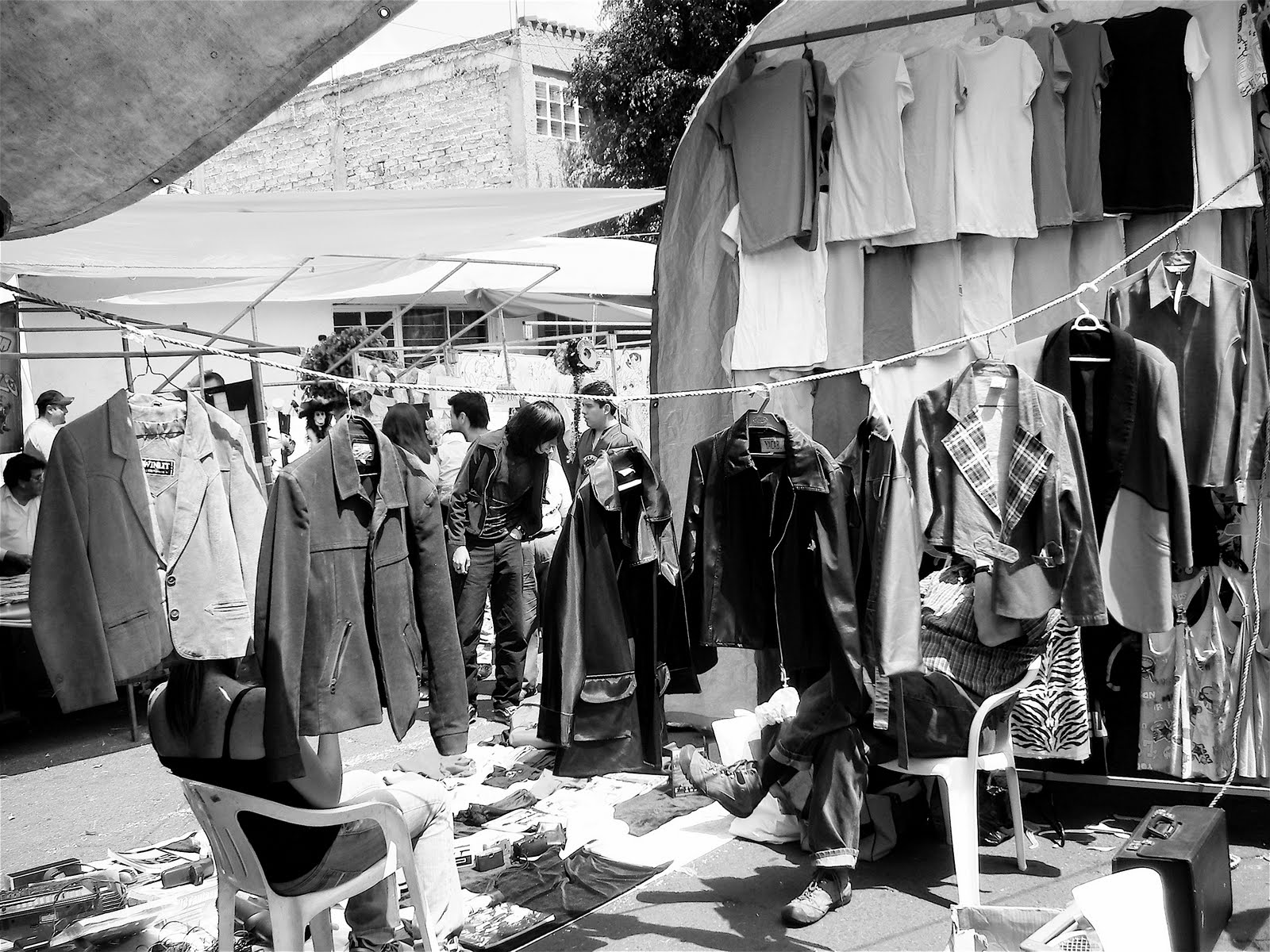
Each tianguis is unique in what they offer. Some focus on fruits and vegetables; others do food stalls, furniture, antiques, cars, etc. Ours is more like a US strip mall -- it has a little of everything with over 300 stalls spanning about 10 streets. Here is what's inside our strip mall:

Walgreens

Goodwill

Pro-Cuts

Krispy Kreme (actually not donuts but mini gorditas de nata)

Sally's Beauty Supply

Guacamolería/Aguacatería

Nick came down with mall-itis and became disorientated at the sight of all that there was to buy. So, probably, on future Sundays, I'll leave him to watch football while I gorge myself on fruits and vegetables and barbacoa tacos.

Thursday, August 19, 2010

Learning eh-slang via YouTube

We're coming on **two** years here in Mexico, and I'm finally getting around to understanding and using slang. Which pretty much means I'm finally learning to speak Spanish... While I highly recommend the blog Effective Swearing in DF for lovely explanations of slang, I find this YouTube sensation, Werevertumorro, to be pretty amusing. He teaches me lots of useful slang, and I like his social commentary on the craziness that often goes on here.

See how many references to Mexican pop culture, TV, and futbol you can get in this video:

Wednesday, May 26, 2010

Losing & Reclaiming Traditions

One of the most valuable lessons I've learned while living abroad happened while attending Samant's wedding in India last week. The thought started here in Mexico, when one Sunday a few weeks back, I noticed an eerie quiet around 2 pm. Nick and I were wandering around the neighborhood, probably in search of something to eat -- I don't remember.

But, I remember picturing a family -- grandma, grandpa, mother, father, sisters, brothers, sons, daughters, nieces, nephews, and probably a few great-somethings in the mix -- gathering around the table for Sunday brunch. An unspoken tradition that happens every Sunday, even if you have to pull yourself out of bed bien crudo to get there.

I felt so alone. Sure we had friends we could call on to recreate this family tradition, but family is family, and I craved to be surrounded by family at that moment. This is the life you chose, Alice. You squandered something few have -- both families in the same town.

We arrive in New Delhi three days before the wedding, and our plan is to stay in a B&B on our own, go shopping, eat kebabs till our teeth fall out, and stay out of Samant's hair as he prepares for his wedding. We'd find our way to his house on Thursday for the first planned event.

So very American thinking. The next morning, less than eight hours after we arrive, Samant calls us to invite us out for drinks that night. He wants us to meet Sneha, his bride, and other family. Then, each day thereafter, Samant would ring us to know our plans, and if we were free, to go shopping with them, come over for dinner, etc. I kept thinking, don't you have something more important to do -- like plan your 4-day wedding -- than hang out with us? Again, so very American of you, Alice. Weddings are for being with family, and Samant considers you family.

We realized this early into our trip, and we didn't resist. We joined in every scheduled wedding function (except one, and the family noticed), and we met Samant's parents, brother, uncles, aunts, and cousins (who, in India, are referred to as brothers and sisters. And if they see the look of confusion on your face, they clarify, "Oh, he's my cousin brother/sister."). Even on Thursday, when the wedding festivities were commencing, Samant and his brother took me and our mutual friend, Varun, to the Karol Bagh market. Not exactly the tranquil kind of thing I'd want to be doing if I were getting married, but I'm glad they did. We ate some of the best foods I've ever had in my life.

At the end of the wedding, after an intense number of waking hours together, we were hugging, exchanging numbers, and asking when the other was coming to visit. We had that deep family feeling connecting us. The kind where if we came back to Delhi without telling them, and they found out, we'd be shamed.

I don't recall the exact moment when I had my epiphany, but somewhere in the madness of wedding ceremonies, I felt very satisfied. I said to Nick, "I like the tradition of being with family. If we're going to continue living abroad, let's make a commitment to see our family at least once a year. Get everyone in the same place at least once."

In typical husband-like brevity, he replies, "Ok."

In places like Mexico and India, the tradition continues without effort. Because they know the importance of something we've forgotten. Family oils the gears of life. Family keeps us happy and socially adjusted (I know, not always). So while I can't undo the fact that we've moved far away from family, I can try to reclaim what's been lost. Even if it is just once a year.

Friday, March 5, 2010

The Long Sit

Last weekend, the weather we all know and love came back! The rain had let up, the sun was out, and it was just one of those days to be outside. We were in the mood to try some new beers, and Lucille's in Roma serves Minerva, Tempus, and Cosaco (sadly, Duff is off the menu). We rang up some friends to meet us there for lunch, which, on the weekends, is somewhere around 4 pm.

Now, my idea of taking advantage of the weekend doesn't usually entail getting it going around 3, but you soon find out that your friend circle will be very small if you ask them to meet you for lunch any earlier on the weekend. So, to appease my inner early-bird, I do any errands or chores beforehand, because, I KNOW, and as you'll soon see, that the rest of the day can quickly turn into one long and continuous gathering.

Back to 4 pm. The friends arrive, we lunch, and then head back to the pool tables. It quickly turns into 6, at which time another set of friends join us "for lunch". The American in me is ready to call an end to lunch, but the trying-to-be-culturally-sensitive side of me decides that we should stay because 6 o'clock lunchers like to have company just like the 4 o'clock lunchers.

Fast forward the clock to 7, then to 8, 9, 10, and 11, and we're all still sitting there having "lunch". One leaves for a bit to grab dessert, another to get some cigarettes, and it all seems too normal to run errands while lunching. I guess if you weren't like me, and you didn't complete your errands before, you might as well complete them DURING lunch.

By midnight, I was all lunched out. I felt like the rude foreigner ending the festivities early. I mentioned that I had never lunched so long, to which I got, "What? You've never sat down to lunch for 8 hours?" Sorry, no. And, sorry, I need to go.

Our friends waved us goodbye, with no intention of leaving, and we stumbled home, half proud that we were gaining Mexican social stamina and half in wonder with where the day had gone.

Friday, February 5, 2010

Street Peddlers Know Random

Gosh, that last post was way too depressing. Let's get back to why I love Mexico.

Mexico thrives on its informal economy of street peddlers, and I was very fascinated by this when we moved here. Instead of hopping in your car to reach the neighborhood Target or Wal-Mart, you go to one guy for the lightbulb you need to replace, another guy for a black marker you need for school, and the dude down the street to fix your broken watch. Whatever you might need, you don't have to go too far to find it on the street.

Over time, the novelty of going here and there to get my shopping done became routine. But, still, the juxtaposition of completely random items is funny to me. In front of the World Trade Center in Colonia Nápoles is an old man selling the typical gum and cigarettes, but then he also has one or two bags of freshly fried churros. I don't know about you, but I'm a little weary of a man that sells gum with three churros hanging off the side. Wouldn't you rather buy your churros from the boy down the way?

Also, if you're ever on Calle Monterrey in Colonia Roma, you can usually find the same three men: one selling Bob the Builder belts, another selling chalkboards, and another selling miniature guitars. I always wonder what the demand (and the supply, for that matter) is for Bob the Builder belts.

And, finally, if you will turn your attention to the picture below. Next to the stand where I fetch my favorite Friday treat of chicken flautas is a young, good looking young lady (in black) selling a strange assortment of home wares. Mainly, she has drain covers, soap dishes, and rubber chair leg pads, and minorly (a word?), she has two spray bottles, three plungers, and one bath mat. She was so intensely trying to sell someone (lady in purple shawl) a drain cover that I thought to myself, "Wow, I am so intrigued by her enthusiasm for drain covers!" If I were selling drain covers, soap dishes, and leg pads for 8-10 hours a day, I might not be as enthusiastic. Doesn't she look like she's having the time of her life?

Sooo...what randomness have you seen in Mexico these days?

Monday, January 4, 2010

La Canasta Básica

I'm still not brave enough to tackle the Mexican newspaper, but this morning, I walked past the neighbor's door and glanced at today's headline "Canasta Básica subirá 30%". Canasta básica? The basic basket? Another term for inflation?

Not being knowledgeable about economic terms, I went to my trusty online dictionary, which translates canasta básica into "basic food basket" or "basic market basket". Then, I wondered what could possibly be in the basic food basket?

If you imagine the average Mexican family strolling around the supermarket, what might be in their cart? Tortillas, tomatoes, limes, beans, rice, oil, laundry detergent? Well, that's essentially the basic market basket -- goods and services deemed by the government to satisfy basic family needs.

Examining the list, it's interesting to note what's essential. This article from 2008 provides a good summary of the origins of the term, the eventual inclusion of more than just food, and the 2002 list by the Bank of Mexico. Did you know essentials now include the movies, TV, and sodas?

I like to look at the list for comparison -- just how Mexican is my daily living becoming and how do the basic goods and services differ between Mexico and the US? I don't know what would be in the typical American basket, but I doubt powdered gelatin (Lesley is always observing how much Mexicans like their gelatina) and beef liver would be. And, if I were to guess what might be on the American list ... macaroni and cheese and Hamburger Helper?

Wednesday, December 2, 2009

Letting Men be Men

Besides the safety issue, another issue that I realized I've become numb to while living in Mexico is the machismo attitude. The kind of manliness that drives many men here to whistle, honk their horns, yell crude pick-up lines, and even engage in 180 degree head turns when women -- particularly bust-a-licious or booty-licious women -- walk by. And, as amorous as couples seem here, there's a good chance that the man, while hugging and kissing his woman, has his eyes open, gazing at the other women walking by. To combat these machismo ways, I've learned to dress modestly, avoid eye contact, stare down at the pavement, walk quickly, and wear my iPod. But only when I'm alone; most men wouldn't dare say something when I'm with Nick. There are rules to this game, y'all...

Another machismo attitude that I find really disheartening is that many men here keep other women in addition to their wife/girlfriend (or, for lack of a better English word, their mujer). A security guard at Nick's work likes to brag about his women, that he can keep them all by "getting in and out quickly." When questioned about his wife, he replies "Ahh, no importa!" Or, my taxi driver de confianza that openly confesses to me about the many women he has despite having a mujer.

Cheating happens a lot, so much so that it's making me rethink the machismo attitude here in Mexico. Not so much the affairs, but the catcalling and such. As in, this open type of self-expression is very genuine. It's a very real and biological need that men have. Is it still annoying? Yes! Do I think there are better ways to meet one's needs? Definitely! But, I'm over the catcalling. Let men be men, and I'm just gonna keep on keepin' on with my frumpy clothes and anti-social street persona.

Monday, September 21, 2009

What Line?

Forming lines is not natural. In school, children do not naturally gravitate to forming lines, and we spend lots of time teaching and reteaching the art of lining up. I have put tape on the floor, we put down signs in the hallway that say "STOP HERE", and teachers repeat ad nauseum, "It doesn't matter who's first..."

From having spent some time in England, I believe Brits do the queue the best. They know the rules of lining up very well, and if you don't, everyone will let you know that "the line's back there." The Japanese, too, line up well, but they're usually too shy to confront someone who's broken the rules. According to this website , before visiting Sweden, you should know that cutting in line is taboo because Swedes "like lines."

Probably most of us prefer lining up to mob culture because we're used to lines and we see the value in order. It makes sense, no? If you came to the bank earlier, you should be served before the person who just got there? Clearly, not everyone thinks so.

There have been many times that we have been standing in line for something -- and usually for awhile -- and someone will walk up and cut in front of everyone. Sometimes people will say something to the effect of, "Sir, there's a line" or let the cashier/attendant know that that customer just cut the line, but cutters usually get their way. One time, Nick said something to a line-cutter after waiting in line at the bank for more than 30 minutes. The cutter got in Nick's face and threatened to beat him up. Ok, adelante, señor...

There are some cultural adjustments that take longer than others to get accustomed to, and this is one. I admit, I get overly worked up by line-cutters. My insides get hot and riled up. I start to feel blood rushing to my head. Patience, patience, patience, I have to tell myself. It's the most important virtue I've been learning here in Mexico.

Friday, September 18, 2009

A Lie That's Become Truth

When living in Mexico, finding ways to break bills is a constant and strategic battle we all face every day. And most people don't mind lying and being lied to about change (see comments from my last post about change). Is it just me who's SO hot and bothered about lying?

I started a new job recently that requires me to commute by taxi to work and back. A more economical way is to find a driver, and that seemed like a good idea so I wouldn't have to call up a taxi service and give directions every day. An acquaintance recommended her driver, and he was willing to take me for 30% less than a taxi service. Sounded fabulous.

On the very first day the driver was supposed to pick me up, he didn't show up. I called his cell phone, he didn't pick up, I ended up taking a taxi, and was late to work (fine for a Mexican employer but not okay for my American employer). Since he never called to explain himself, I was deciding later that day whether to call him or not. #1: Talking on the phone in Spanish still isn't easy, and #2: I needed to have an uncomfortable conversation with this guy in Spanish and let him know what he did was NOT okay.

I rang him up in the evening, and I'm not sure what to think about the bag of lies he fed me. He said his car broke down and that he told our mutual acquaintance to call me. Bro, "my car broke down" is one of the lamest, over-used lies in the book of Mexican excuses. I can't tell you how many times we've been told that lie, and it's so common that it's nearly a truth. Just like lying about change -- you start to hear it and use it so often that it becomes a personal truth.

Part of me wants to give the driver another chance because this kind of lying is not really considered lying, but the American side of me wouldn't give this guy a second chance. At least tell me a believable and original lie, man. Still not sure what I'm going to do because if he does something like this the first time, he's likely to do it over and over again.

Monday, September 14, 2009

Patriotic Street Food

One year ago, Nick and I were in a such a state of disorientation that we failed to embrace the festive atmosphere in the weeks leading up to September 16th, Mexico's Independence Day. Taxis and buses waving flags from their windows and buildings lit up and decorated in patriotic colors. I remember seeing street carts selling flags, pins, and toys in red, white, and green, and I vaguely heard about pozole (hominy soup) and chiles en nogada (stuffed poblano chile in a walnut cream sauce). Once we figured out what chiles in nogada was, the season had passed (yes, chiles en nogada has a season -- as if it's produce -- and it's only in September), and we looked forward to this year when chiles en nogada would reappear.

Well, chiles en nogada and I walked into each other lives, literally. On Sunday, while taking a stroll down a street I know very well, I noticed an older lady with a food stall right in my path. I thought, "Hmm...she's never been here before. Not only is she in my way but so are a lot of other people, and now she's made me hungry." Having seen the rice and ground meat, I had a hunch she was selling the elusive chiles en nogada.

Let me tell you that this was the best-ever street food find, and quite possibly one of the best dishes I've ever tried. With the walnut cream sauce, pomegranate, almond slivers, raisins, and pieces of fruit, it tasted very Mediterranean. But then again, the stuffed poblano was very Mexican. It was very intriguing, and the accompanying rice was a little too good. Never mind that we had just eaten breakfast 30 minutes earlier, and never mind that Nick's stomach was having a fit, I can never pass up a street food opportunity such as this.

Before September ends, and like many others, I am on a mission to eat this as many times as I can, especially because I missed nearly half a month of it already. I liken it to my obsession with eating as many turkey-related dishes and pumpkin pie around Thanksgiving and Christmas before a 10-month dry spell.

If you count points with Weight Watchers, chiles en nogada may be the only meal you can eat for one week. And, if you choose to sop up the nearly one cup of cream with a piece of bread (as is the practice), this may be your only meal for a month.

Monday, September 7, 2009

Meet Mr. Tengo Miedo

Mr. Tengo Miedo is a YouTube legend. Get together with a group of Mexicans, and when the timing's right, repeat the following words with increasing intensity: "Tengo miedo, tengo miedo, TENGO MIEDO!!" (I'm scared). Then, as if you unlocked the magic words, everyone will erupt into laughter.


Apparently, Juan Pablo Carrasco was so inflamed with the police for wanting to check his blood alcohol level that he tried to avoid taking a breathalyzer test by repetitiously yelling the now famous phrase "Tengo miedo!" If you, too, have fears of any kind -- the police, the dark, the man next door -- join Juan Pablo in his campaign to END ALL FEAR. Or, add more joy and laughter to the world by downloading the ringtone for 10 pesos.

Friday, September 4, 2009

Sir, why can't you find something else to read besides El Grafico?

I read an interesting article this morning in the New York Times about how New York City subway commuters like to read during their commutes. People are reading all kinds of things -- magazines, books, newspapers, scripts, the Talmud, and shopping catalogs -- and this made my teacher-self all warm and fuzzy inside. Nick said that when he lived in New York, he enjoyed the commute because he could read the paper or do crossword puzzles. It was a calming, zen-like experience for him.

Well, I don't know what it is, but I find very few people reading anything on the trains and buses here. People sit. Some talk if they're with family or friends, but most people just sit. Or stand. A few are reading the tabloid-style, nasty, bloody El Grafico. I did notice one guy this week reading a book, and I remembered and noticed because I thought that was unusual behavior. And it's even more unusual to me after reading the article. Why aren't more people reading? Commutes are LONG, and one could really get a lot of reading in. This intrigues me as a teacher who sings the praises of reading everyday in the classroom.

In the US, I expected my students to read every night, to always have reading material with them at their desk, and to read whenever they're done with their work. We encourage parents to read to their children at night, to have lots of books at home, and to use the library. We value a literate culture. However, from my experience here in schools, I don't see teachers praising literacy like we do in the US. Kids aren't engaging in self-selected reading during the school day, teachers aren't spending time reading books aloud, and I don't know anyone who uses the public libraries (in Mexico City, many parks have library branches).

Even I don't read on the train or the bus -- I download NPR podcasts to my iPod. For one, the subway and buses would give me vertigo if I looked down. There is a lot of sudden braking and screeching halts, and you have to be a "defensive passenger", constantly adjusting how tightly you squeeze the railings. And secondly, there's a lot to see out the windows. The people watching is world-class, and the food...oh, the food!

In large part, Mexicans aren't reading is because it's expensive. One of the things that astounded me when we moved here was how expensive it was to buy books. If you're making less than $10 per day, why would you spend your entire day's salary buying a book? Actually, a non-pirated book will set you back more than $10. A hardback copy of a quality children's book is usually over $30. Why is that??

If books were cheaper, if student's read more in school, if parents read to their kids at home, imagine how different things might be...

Friday, August 21, 2009

Crazy Man in Spanish Class & Calderón Legalizes Drugs (sort of but not totally related)

In every Spanish class I've taken here, there's been some Columbine/Virginia Tech crazy that makes me afraid to go to class. In the fall, there was a fella from the US that didn't like a girl in class. He was so frustrated with her one day that he let her have it, insulted the way she spoke Spanish, walked out, and never came back. It shook us all up, and even I was left in tears because of the sheer meanness that some people can have within them.

This summer, I switched language schools, and there was one very manic Korean guy. He had a bad experience in Mexico and seemed to want to take revenge on the teacher and all Mexicans. When we learned a new grammatical structure, he would practice it by bashing Mexicans. For example, "If you trust a Mexican, you will lose all your money" or "You can get whatever you want in Mexico if you bribe a cop."

Then, on Monday this week, we got into a discussion about the legalization of drugs, and the Korean guy insisted that marijuana was legalized a few months ago. Everyone disagreed with him, so he left the room, called his lawyer friend, and went to the library to print out proof (but he ended up printing an op-ed piece). His friend -- apparently the authoritative god for this guy -- reaffirmed that the law had passed. Our homework was to find our own proof, and we all came back with the same Reuters article: that the law had passed in the Congress in April 2009 and was awaiting the President's signature.

Well, this guy was beyond upset that the teacher didn't believe him, and at that point, I thought he was going to pull out a gun. He threatened to bring in his lawyer friend, and he said that he cannot respect a person that does not change their mind after being given definitive proof. Anyway, it was clear he had his mind made up despite our definitive proof, and it was also clear to me that "one's word" seems like a very important cultural value in Korea. Oh, the joys of our United Nations discussions in Spanish class...

And, now, after all the drama and Mexican disrespect, here is the TRUTH: Calderón finally signed the law this week, and many types of drugs are now legal in Mexico in varying proportions. No more crazy debates in Spanish class about the legality of drugs in Mexico because it's here. W-O-W. Imagine what this weekend is going to be like?!?!

Thursday, August 13, 2009

When In Enemy Territory, Wear Your Colors Timidly OR ELSE...

After a few naughty fingers, evil stares, and a threat to beat us up after the game, we're ALIVE!! And all this maliciousness brought on by wearing a USA jersey at the game. We had some hesitation, er, fear, that wearing a USA jersey in a sea of Mexican green might bring on some undesired attention, but our Brooklyn-blooded-I-have-NO-fear friends were expecting us to bleed red, white, and blue along with them. So we compromised and stashed our jerseys in my bag until we reached our seats. You know, 'cuz if there was ever a time to be low-profile, this day was it.

Once we reached our **UH-MAZING** seats (thanks to super fan, Dwight, who vigilently stood in line at Ticketmaster for us), we donned our jerseys and Dwight proudly hung up the American flag. It just so happened that we were fortified by a large cement wall -- aka the beer retaining wall -- and barbed wire, and the people in our section seemed somewhat more civilized than the average beer-throwing, taunting young gun. All turned out to be very good things once we realized that we were not in good company.

One day we will show this to our children and advise them that branding your colors on enemy territory might get you beaten up.

There were taunts like, "Yankee go home" and "America sucks," and every time the Mexican team scored a goal, people physically turned their bodies and launched all their anger and pent-up George Bush hatred towards us to suck up. The odds were 6 to 120,000.

Well, the game didn't go well (now we know why: Donovan has AH1N1) , and when Mexico made the second goal in the final minutes of the match, we quickly untied the flag, took off our jerseys, and filed out of the stadium as fast as we could. One young 'un in particular really wanted to fight us, and at that point, we decided to lay down our American pride and walk out with lowered heads. Disappointing. Exhilirating. A once in a lifetime experience.

Here are a few more pictures of the game:

Estadio Azteca seats nearly 120,000 riled up Mexican fans.


The starting line-up


Per Mexican machismo, the pretty girl parade during half-time


This bad boy enjoyed turning around and flinging the finger at us.

Friday, July 31, 2009

Daily Observations

This week I noticed that the constant noise and rumble of traffic doesn't bother me like it used to. The trash man's bell, the knife sharpener's whistle, the honking horns--all sounds good and bad--were something I took notice of. Now that we're coming on a year here in Mexico, I was wondering if the newness of it all was settling into something regular. So I thought I'd write down a few observations over the past few days to remind myself that there are still some things that make me go hmm...
  • From a subway car, I learned how to get a free abortion if I were so inclined. In bullet point format, a poster laid out the requirements and the procedure which includes a proof of residence (the elusive comprobante domicilio), proof of age, etc. 
  • From another subway car, I was told about the 10 peso (70 cents) meal I could get my hands on at any of the 300 outlets operated by the municipal government. Plus, 50 more places where I could get a free meal. 
  • Man taking up an entire lane on Paseo de la Reforma, one of Mexico City's busiest streets, to push a two-wheeled wooden cart. That's some cojones, señor...
  • I'm biking down the street to get to Spanish class, and I find myself in the company of delivery men. They're delivering water, breakfast, fresh-baked bread, tortillas, produce, and let's not forget the mail.
  • A young couple holding each other tightly on the bus with their lips locked together. They're in my direct line of view, so I try to find a way to divert my gaze so as to not look like a gawker. Very awkward. And gross.

Monday, July 6, 2009

Do We Look Like We're Made of Money?

They tried taking our shoes; now they're trying to take our money. On two different occasions, both doormen have asked us to borrow money. They asked for 100 pesos ($7.50) each, and while it's not a lot of money for us, it's a lot of money for them and a lot to "borrow"--"borrow" because I don't think they intend on returning the money. 

Carlos asked the first time. He said he needed it desperately and would pay us back. We loaned him the money, and after hounding him several times, we gave up trying to recover the borrowed money. We instead called it even by having him wash our car a few times.

Felipe, our most trusted and hard-working doorman, asked yesterday. He, too, wanted 100 pesos but didn't say why. We were startled that he asked, actually, because he's always very kind and humble. It seemed out of character for him to ask for money. 

This might also be a way of trying to retrieve some tip (because service workers want a tip after completing even the most minute tasks). Like a roundabout way of saying, "Can I have 100 pesos because you're not giving me tips to take out your trash?" The thing is, we pay a hefty month fee for maintenance/doormen, and we give them a generous cash gift on special occasions, like Christmas and Easter. It's our way of thanking them and more than covers the nominal tips they are supposed to receive.

I'm very baffled by the situation. Although they're not family, we interact daily and have gotten to know them. Asking for money is a very personal matter, and it puts us in an awkward position. I'm not really sure what their motives are, or perhaps we're missing some cultural concepts here about borrowing money. Whatever it is, we feel like they're burning bridges by asking us for money and not returning it. We are less inclined to give as generous a gift in the future, and we definitely won't ever loan them money again. 

If you've ever encountered issues like this, I'd like to hear from you. What do you do here when asked for money? 

Saturday, July 4, 2009

Case of the Missing Shoes

Nick and I both grew up taking off our shoes before or when we entered the house. In Taiwan and India, where our parents grew up, shoes are usually taken off before you enter the house. The thinking is twofold--the outside stays out, and, practically, the house stays cleaner. In front of everyone's door are piles of shoes, and depending on the family, it runs from super-organized to a huge mess. 

A mess of shoes at the front door

In the US, we mostly take off our shoes right after we step into the house. There's usually a foyer area, and I guess it's mentally seen as part of the outside. Similar to the genkan idea in Japan, where the front area--even though it's actually inside your door--is considered public space. 

An example of a Japanese genkan

Here in Mexico, we don't have a foyer area, but we've chosen to take off our shoes right when we walk in. We sort of delineated a 3-4 step "foyer" area that we give ourselves permission to put and keep our shoes on. (Ha! Now that I think about it, it's funny how we both unspokenly decided on our shoe rule.) Anyway, it's not a common practice here in Mexico, and we usually remind guests to take their shoes off when they enter. The usually remark back is, "Oh, I hope my socks don't have any holes in it." Some, if they're only stepping in for a moment, would rather stand near the door than take off their shoes. 

Recently, I've been thinking a lot our shoe habits because two incidents have prompted Nick and me to talk about our taking-off-our-shoes options. When Nick's parents were here, we were caught in a huge rainstorm and all our shoes were wet. We all decided to take our shoes off outside the door and leave them until they dried. 

Before we went to bed, I asked Nick to take in the shoes. When he opened the door ALL THE SHOES WERE MISSING!! Nick's parents were already in bed, but the mystery woke us all up and we convened on the couch. Nick went downstairs to ask the doorman if he knew anything about the shoes, and he did. He embarrassingly said that he threw them in the trash because we had our shoes where we usually put our trash out for him. So, around midnight, Nick went to the trash bin and reclaimed our shoes. 

Today, again, I encountered our other doorman mistaking my shoes for trash. Yesterday, I left my shoes outside again because they were wet. When I opened the door to put out the trash, I saw my doorman with my shoes in his hand. He asked, "Are these trash?" And I, in my amazement that this was happening again said, "No, no, no." 

We are a little bewildered that our doormen keep mistaking the shoes outside our door for trash. Obviously we're having a cultural miscommunication, and they must be as baffled by what we're doing as we are by what they're doing. When it happened once, we thought something was wrong with our doorman; when it happened again, I realized the cultural difference. We considered a sign--something to the effect of "Our shoes are not trash!"--but I think a little explanation will do the job. 

Thursday, July 2, 2009

Rain-drying the Laundry

Before I even get up, the two ladies across the street already have their laundry hung up for the day. The trick is to get it up in the morning and have it down before the afternoon rains. But what happens if there's rain in the morning, too?  

Well, duh! Hang it up in the rain...